
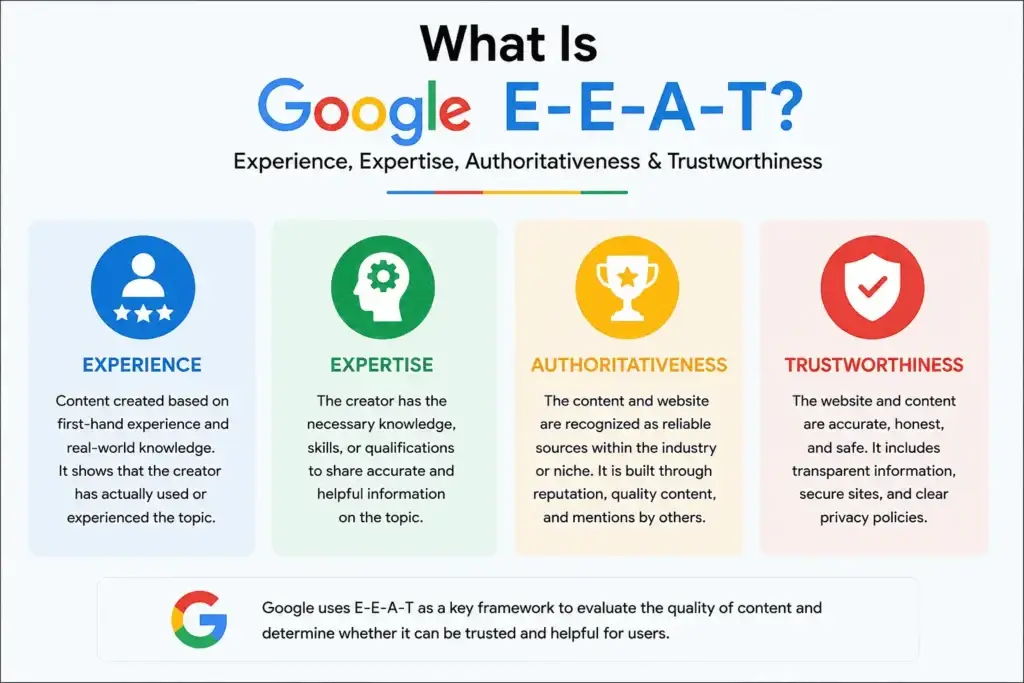
What Is Google E-E-A-T? A Complete Guide to Experience, Expertise, Authoritativeness & Trustworthiness
Google E-E-A-T is an important concept for anyone who wants to create useful, trustworthy, and high-quality content online. It stands for Experience, Expertise, Authoritativeness, and Trustworthiness.
Google uses these concepts when evaluating the quality of content. They are especially important for websites that provide information that can affect a person’s health, finances, safety, or major life decisions.
But what does E-E-A-T actually mean? Is it a Google ranking factor? And how can businesses improve E-E-A-T through their content?
This guide explains everything you need to know in simple terms.
What Is Google E-E-A-T?
E-E-A-T stands for:
- Experience
- Expertise
- Authoritativeness
- Trustworthiness
Google introduced the additional “E” for Experience in December 2022. Experience focuses on whether the content creator has first-hand knowledge of the topic.
For example, a person who has actually used a product can provide practical information about that product. A person who has visited a destination can share first-hand travel experiences.
Expertise focuses on knowledge and skills. Authoritativeness relates to the reputation and recognition of the website or content creator. Trustworthiness focuses on whether the information and website are reliable.
Among these four concepts, trust is particularly important.
What Does E-E-A-T Stand For?
1. Experience
Experience means first-hand involvement with a topic.
Google’s quality guidelines consider whether the creator has actually experienced what they are discussing.
For example, a travel article can become more useful when the writer has personally visited the destination. A product review can be stronger when the reviewer has actually tested the product.
You can demonstrate experience through:
- Original photographs
- Personal observations
- Case studies
- Product testing
- Real project examples
- Step-by-step demonstrations
- First-hand results
Experience helps make content more useful because it adds information that generic content may not provide.
2. Expertise
Expertise refers to the knowledge and skill of the person creating the content.
An expert does not always need a formal qualification. The level of expertise required depends on the topic.
For example, medical content generally requires strong professional expertise. A personal hobby blog may demonstrate expertise through years of practical experience.
You can demonstrate expertise by:
- Providing accurate information
- Explaining complex topics clearly
- Showing relevant qualifications
- Including author information
- Using reliable sources
- Sharing professional experience
- Keeping information updated
Good content should answer the user’s question accurately instead of simply repeating information found on other websites.
3. Authoritativeness
Authoritativeness relates to the reputation of the content creator, website, or organization.
A website can build authority when other trustworthy websites recognize and reference its content.
Authority can develop through:
- Quality backlinks
- Industry mentions
- Expert contributions
- Positive reviews
- Original research
- Strong brand recognition
- Helpful, consistent content
However, authority does not come from backlinks alone. The overall reputation of the website and its creators also matters.
4. Trustworthiness
Trustworthiness is one of the most important parts of E-E-A-T.
Users need to know that they can trust the website and the information it provides.
A trustworthy website should clearly communicate:
- Who created the content
- How the content was created
- Where information came from
- How users can contact the business
- What organization operates the website
You can improve trust by providing accurate information, transparent business details, secure website functionality, clear policies, and reliable sources.
Is E-E-A-T a Google Ranking Factor?
This is one of the most common questions about E-E-A-T.
E-E-A-T itself is not a single Google ranking factor.
Google does not give every website an E-E-A-T score that directly determines its ranking.
Instead, Google uses various systems and signals to identify useful and reliable content. Its Search Quality Rater Guidelines use E-E-A-T as a framework for human quality raters to assess search-result quality.
This means you should not try to “add E-E-A-T” as if it were a technical SEO setting.
Instead, focus on creating genuinely helpful content and building a website that users can trust.
Why Does E-E-A-T Matter for SEO?
E-E-A-T matters because search engines want to provide users with useful and reliable information.
Imagine searching for advice about an important financial decision.
Would you prefer an article written by an anonymous website with no sources or an article that clearly explains who wrote it, provides evidence, and demonstrates relevant experience?
Most users would choose the second option.
This is why E-E-A-T should be part of your broader SEO strategies.
Strong E-E-A-T can help businesses create better content, strengthen credibility, and provide a better user experience.
How Can You Improve E-E-A-T?
Improving E-E-A-T is not about adding a single badge or technical setting to your website.
It requires consistent effort.
Show Who Created the Content
Add clear author information to important articles.
An author bio can explain:
- The author’s experience
- Professional background
- Qualifications
- Areas of expertise
- Relevant achievements
This gives readers more context about the person behind the information.
Share First-Hand Experience
Whenever possible, add original experience to your content.
Instead of writing generic product information, explain what happened when you actually used the product.
Instead of copying general marketing advice, provide examples from real campaigns or projects.
First-hand information can make content more useful and unique.
Use Reliable Sources
Support factual claims with trustworthy sources.
For topics that require evidence, use information from:
- Government websites
- Universities
- Industry organizations
- Research institutions
- Official documentation
- Recognized publications
Do not rely on questionable sources simply because they rank well.
Create Original Content
Avoid creating articles that simply rewrite what other websites have already published.
Add something useful.
You could include:
- Original research
- Case studies
- Examples
- Expert opinions
- Data
- Personal experience
- Practical steps
Original information gives users a reason to choose your content over competing pages.
Keep Content Updated
Information can become outdated quickly.
Review older articles regularly and update information when necessary.
Check:
- Statistics
- Examples
- Links
- Product information
- Industry developments
- Google guidelines
- Screenshots
- Recommendations
Updating content also helps prevent users from receiving outdated information.
Make Your Website Trustworthy
Your website should make it easy for users to understand who operates it.
Important pages can include:
- About Us
- Contact
- Privacy Policy
- Terms and Conditions
- Author pages
- Service pages
For businesses, displaying accurate contact and company information can also improve transparency.
E-E-A-T and AI-Generated Content
AI tools can help content creators with research, brainstorming, outlining, and editing.
However, simply generating large amounts of AI content does not automatically create high-quality content.
The key question is whether the content provides value to users.
AI-generated content can become stronger when humans add:
- First-hand experience
- Expert review
- Original examples
- Real data
- Case studies
- Accurate sources
- Unique insights
The goal should not be to publish as much content as possible.
The goal should be to publish useful content that satisfies the user’s needs.
How E-E-A-T Applies to Digital Marketing
E-E-A-T is especially relevant to digital marketing because businesses need to establish credibility online.
A digital marketing professional can demonstrate experience through real campaigns, case studies, client results, and practical examples.
Expertise can be demonstrated through knowledge of SEO, content marketing, social media, paid advertising, analytics, and other digital channels.
Authority can grow through industry recognition, quality backlinks, expert contributions, and a strong online reputation.
Trust can come from transparent communication, genuine testimonials, accurate claims, and clear business information.
For local businesses, these signals can become even more important because potential customers want to know who they are dealing with before making a decision.
E-E-A-T Checklist for Your Website
Use this simple checklist to review your website:
Experience
- Do you include first-hand insights?
- Do you show real examples?
- Do you use original images where appropriate?
- Do you provide case studies?
Expertise
- Is the author qualified to discuss the topic?
- Do you provide accurate information?
- Are important claims supported by reliable sources?
Authoritativeness
- Does your business have a strong reputation?
- Do reputable websites mention your brand?
- Do you publish useful industry content?
Trustworthiness
- Is your business information clear?
- Can users easily contact you?
- Do you have transparent policies?
- Are your claims accurate?
- Do you clearly identify content creators?
Frequently Asked Questions About Google E-E-A-T
Is E-E-A-T a direct Google ranking factor?
No. Google does not describe E-E-A-T as a single ranking factor. It is a framework used to understand qualities associated with helpful and trustworthy content.
What does the extra E in E-E-A-T mean?
The extra E stands for Experience. It refers to the extent to which content demonstrates first-hand experience with the subject.
Which part of E-E-A-T is most important?
Google’s guidance emphasizes Trust as the most important aspect. The importance of each element can also depend on the topic and purpose of the page.
How can I demonstrate experience on my website?
Use original examples, case studies, photographs, testing information, personal observations, and practical insights that show genuine first-hand involvement.
Does E-E-A-T matter for every website?
E-E-A-T concepts are relevant broadly, but they are especially important for topics where inaccurate information can cause significant harm, often referred to as YMYL topics.
Does AI content hurt E-E-A-T?
Using AI does not automatically make content untrustworthy. What matters is the quality, accuracy, originality, and value of the final content. Human review and genuine expertise can make AI-assisted content more useful.
How can a small business improve E-E-A-T?
Start by clearly identifying your business and authors, publishing useful original content, showing real experience, collecting genuine reviews, using reliable sources, and keeping important information updated.
Conclusion
Google E-E-A-T is about more than SEO.
It is about creating content that demonstrates real experience, knowledge, authority, and trust.
Businesses should focus less on trying to manipulate search engines and more on creating content that genuinely helps people.
Show who you are. Demonstrate what you know. Share real experience. Support important claims with reliable information. Keep your website transparent and trustworthy.
When these principles become part of your overall content and SEO strategy, your website can provide a stronger experience for both users and search engines.