
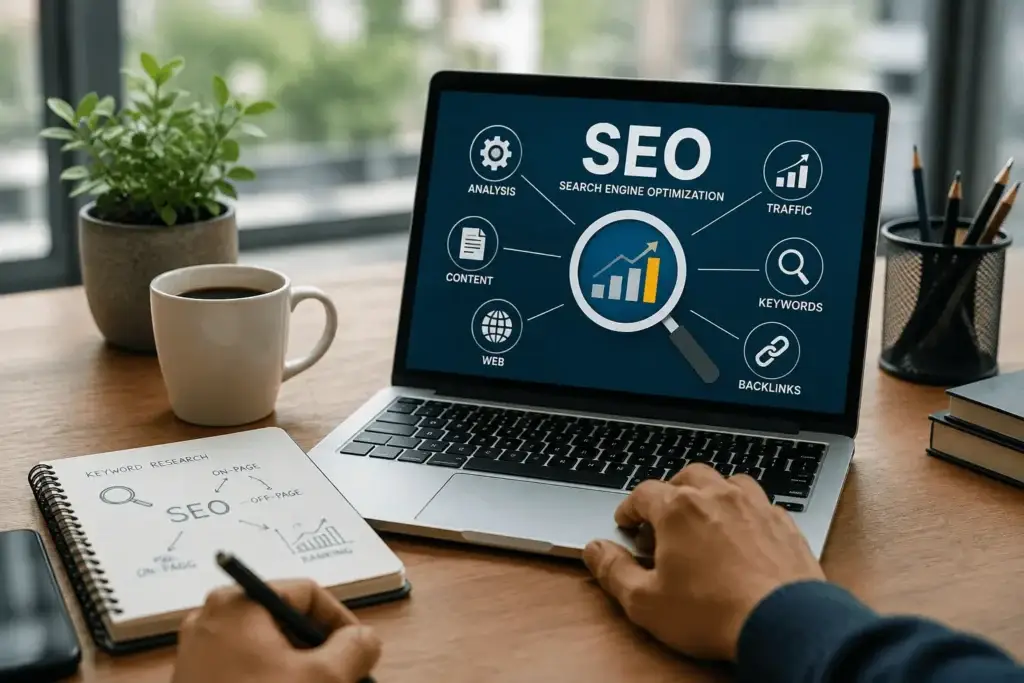
What Is SEO? Types, Benefits, Strategies & Examples
SEO, or Search Engine Optimization, is the process of improving a website so search engines can understand its content and users can find it through relevant searches.
For a small business, SEO can help bring more qualified visitors to a website without relying entirely on paid advertising. It can improve visibility, support local discovery, and help potential customers find useful information when they are ready to make a decision.
If you are planning SEO for a local business, working with a SEO consultant in Kannur can help you build a strategy around your business goals, audience, and location.
What Is SEO?
SEO stands for Search Engine Optimization.
It involves improving different parts of a website and its online presence so search engines can better understand the site and users can find it more easily.
SEO covers several areas, including:
- Website content
- Page titles and headings
- Keywords and search intent
- Website structure
- Technical performance
- Internal links
- Local business information
- Links and mentions from other websites
- User experience
SEO does not mean adding keywords to a page as many times as possible. Good SEO connects useful content with the searches that matter to the business.
For example, imagine a bakery in Kannur that sells custom birthday cakes. A page targeting a relevant search such as “custom birthday cakes in Kannur” can help the bakery reach people who are actively looking for that service.
Why Does SEO Matter for Businesses?
People often use search engines to find products, services, businesses, answers, and solutions.
A business that appears for relevant searches has an opportunity to reach these users.
SEO can help businesses:
- Increase organic visibility
- Attract relevant website visitors
- Build long-term online presence
- Support local discovery
- Answer customer questions
- Build trust through useful content
- Generate enquiries and sales opportunities
The main value of SEO is not simply getting more traffic. It is getting the right people to your website.
A website with thousands of visitors may perform poorly if those visitors have no interest in its products or services. A smaller amount of highly relevant traffic can be more useful.
How Does SEO Work?
Search engines need to discover, understand, and organize web pages before they can show them in search results.
Google describes its Search process around three main stages: crawling, indexing, and serving search results.
1. Crawling
Search engines use automated systems called crawlers to discover web pages.
They can find pages through links, sitemaps, and other discovery methods.
2. Indexing
After discovering a page, Google analyzes and stores information about it in its index when the page meets its requirements for indexing.
The search engine considers information such as the page’s content, images, videos, and other relevant signals.
3. Ranking and Search Results
When someone searches, Google’s systems determine which indexed pages may be most relevant and useful for that query.
This means SEO is not about following one simple ranking formula.
SEO works by making your website easier to discover, understand, and use while providing content that satisfies the user’s search intent.
What Are the Main Types of SEO?
SEO is commonly divided into several areas. These areas overlap, but each focuses on a different part of search visibility.
1. On-Page SEO
On-page SEO focuses on elements you can improve directly on a webpage.
Important areas include:
- Page titles
- Headings
- Main content
- Keyword usage
- Search intent
- Image descriptions
- Internal linking
- Content structure
- Helpful supporting information
For example, a local interior design company could create a detailed service page explaining its interior design services, process, locations served, and common customer questions.
2. Technical SEO
Technical SEO focuses on the technical parts of a website that affect crawling, indexing, performance, and usability.
Common areas include:
- Website architecture
- Mobile usability
- Page speed
- HTTPS
- XML sitemaps
- Structured data
- Canonical URLs
- Crawlability
- Indexing
Technical SEO does not replace good content. It helps search engines access and understand that content properly.
3. Off-Page SEO
Off-page SEO focuses on signals and activities outside your own website.
One important area is earning relevant links from other websites.
Other activities can include:
- Digital PR
- Brand mentions
- Industry relationships
- Relevant citations
- Content promotion
The goal should not be to collect as many links as possible.
Relevant, natural references from trustworthy sources are more useful than low-quality links created only to manipulate rankings.
4. Local SEO
Local SEO helps businesses become more visible for searches connected to a specific location.
It is especially useful for businesses such as:
- Restaurants
- Clinics
- Salons
- Hotels
- Real estate businesses
- Service providers
- Retail stores
- Local professionals
A business serving Kannur, for example, may optimize its online presence for relevant local searches rather than trying to compete for broad national keywords.
A properly managed Google Business Profile, consistent business information, useful local content, and genuine customer reviews can all play a role in local visibility.
5. Content SEO
Content SEO focuses on creating useful content that matches what people are searching for.
This can include:
- Blog posts
- Service pages
- Product pages
- Guides
- FAQs
- Comparison pages
- Location pages
- Case studies
Good content answers the user’s question clearly instead of creating pages simply to target keywords.
What Are the Benefits of SEO?
SEO can provide several practical benefits when a business applies it consistently.
Builds Organic Visibility
SEO can help pages appear in relevant unpaid search results.
This can make it easier for potential customers to discover a business.
Attracts Relevant Traffic
A well-optimized page targets a specific topic and search intent.
For example, someone searching for “best accounting software for small businesses” has a different intent from someone searching for “accounting software definition.”
Understanding this difference helps businesses create better pages.
Supports Local Customers
Local SEO can help businesses reach people searching for products and services in their area.
This matters when customers need a nearby provider rather than a company serving an entire country.
Creates Useful Customer Resources
SEO encourages businesses to answer common customer questions.
A service company could create content explaining pricing factors, preparation steps, service options, or common mistakes.
This content can help potential customers before they contact the business.
Supports Long-Term Growth
Paid advertising can provide visibility while a campaign runs. SEO focuses on improving the website and its organic presence over time.
However, SEO does not guarantee permanent rankings or immediate results.
Search results can change, competitors can improve their websites, and search engines can change how they evaluate content.
What Are the Most Effective SEO Strategies?
A useful SEO strategy starts with the customer rather than the keyword.
1. Understand Search Intent
Ask what the person actually wants when they search.
Search intent can include:
- Learning something
- Finding a specific website
- Comparing options
- Finding a product or service
- Taking an action
Your content should match that purpose.
2. Choose Topics Carefully
Do not choose keywords only because they have high search volume.
Consider:
- Relevance to your business
- Customer needs
- Search intent
- Competition
- Business value
- Location
A smaller, highly relevant search term can sometimes be more useful to a local business than a broad keyword.
3. Create Helpful Content
Answer the main question early.
Then add useful context, examples, supporting questions, and practical information.
Avoid writing 1,500 words when the reader needs only 500 words to solve a simple problem.
The goal is useful content, not a specific word count.
4. Improve Website Structure
Make important pages easy for users and search engines to find.
Use clear navigation, descriptive URLs, logical headings, and relevant internal links.
5. Strengthen Local SEO
For local businesses, keep business information accurate across important platforms.
Create useful location-relevant content when it genuinely helps customers.
Do not create dozens of near-identical location pages just to target different towns.
6. Measure and Improve
SEO requires monitoring.
Useful areas to review include:
- Search impressions
- Clicks
- Search queries
- Organic traffic
- Important landing pages
- Conversions
- Technical issues
Tools such as Google Search Console and Google Analytics can help businesses understand website and search performance.
What Are Some Simple SEO Examples?
Consider a digital marketing agency in Kannur.
Instead of publishing a generic page called “Our Services,” the agency could create separate, useful pages for services such as SEO, Google Ads, social media marketing, and content marketing.
It could then create supporting content such as:
- How SEO works for small businesses
- SEO mistakes local businesses should avoid
- How to choose digital marketing services
- Local SEO tips for businesses
Another example is a local restaurant.
The restaurant could make sure its business information is accurate, maintain its Google Business Profile, publish a clear menu, and create useful content about its location and offerings.
These actions help both users and search engines understand the business.
What SEO Mistakes Should Businesses Avoid?
Many businesses make SEO harder than it needs to be.
Avoid these common mistakes:
- Repeating the same keyword unnaturally
- Creating content only for search engines
- Copying competitors
- Publishing thin pages
- Ignoring technical problems
- Buying low-quality links
- Creating duplicate location pages
- Expecting immediate results
- Ignoring mobile users
- Focusing only on rankings
A high ranking is useful only when it helps the business reach the right audience and achieve a meaningful goal.
Is SEO Worth It for a Small Business?
SEO can be valuable for small businesses when customers actively use search engines to find their products, services, or information.
But SEO should support the wider marketing strategy.
A business may combine SEO with:
- Google Ads
- Social media
- Email marketing
- Content marketing
- Referral marketing
- Offline promotion
The right mix depends on the business, audience, competition, budget, and goals.
How Should a Beginner Start SEO?
Start with the basics instead of trying to optimize everything at once.
- Identify your most important products or services.
- Research how your customers search for them.
- Understand the intent behind those searches.
- Improve your most important pages.
- Fix major technical issues.
- Create useful supporting content.
- Improve your local presence if you serve a specific area.
- Monitor performance.
- Update content when it becomes outdated.
- Keep improving based on real user needs.
This approach creates a practical SEO foundation without relying on shortcuts.
Frequently Asked Questions
What does SEO mean?
SEO means Search Engine Optimization. It is the process of improving a website and its content so search engines can understand it and users can discover it through relevant searches.
What are the main types of SEO?
The main areas include on-page SEO, technical SEO, off-page SEO, local SEO, and content SEO. These areas work together to improve a website’s organic search visibility.
How long does SEO take to show results?
There is no fixed timeline for SEO results. Results depend on factors such as competition, website condition, content quality, authority, industry, and the work being implemented. Businesses should treat SEO as an ongoing process rather than expecting instant results.
Is SEO free?
Organic SEO does not require paying Google for each click. However, SEO still requires resources such as strategy, content creation, technical work, tools, and professional expertise.
Is SEO important for small businesses?
SEO can be useful for small businesses when their customers use search engines to find relevant products, services, or information. Local SEO can be especially useful for businesses that serve a specific geographic area.
What is the difference between SEO and paid advertising?
SEO focuses on improving organic search visibility. Paid advertising involves paying for advertising placements. Businesses often use both approaches because they can serve different marketing goals.
What is local SEO?
Local SEO focuses on improving a business’s visibility for searches connected to a specific location. It is particularly relevant to businesses that serve customers in a particular town, city, region, or service area.
Can SEO guarantee a #1 Google ranking?
No. No legitimate SEO professional can guarantee a specific Google ranking. Search results depend on many factors, and rankings can change over time.
Conclusion
SEO is not simply a method for adding keywords to a website. It is a process of making useful information easier for search engines to understand and easier for people to find.
The strongest SEO strategies combine helpful content, sound website structure, technical health, relevant authority, and a clear understanding of search intent.
For a local business, the strategy should also reflect the customers and locations it serves. A business in Kannur does not need to compete for every broad search. It needs to become visible for the searches that can genuinely support its goals.
Start with the pages and searches that matter most to your customers. Improve those areas first, measure what happens, and build from there.